Showing posts with label Finland. Show all posts

11 May 2012

Finland's world class education system: a solid foundation for a more balanced society

In a recent article, Polly Toynbee wrote that she wants Britain to "aim for the social and economic balance that thrives in the Nordic nations." Well, Ms Toynbee (and Britain's politicians) would do well to learn from the Finnish education system, because it has managed to promote such an equilibrium by balancing equality with meritocracy. As a result, social mobility and equality of opportunity are a reality in Finland.


Suomi FinlandOver the last couple of decades, this small nation of 5.1 million people living in the 8th largest country in Europe has created arguably the best education system in the world. While the land is one of extremes, where temperatures range from -50C in the winter to +37C in the summer, there is a remarkable level of uniformity when it comes to primary and secondary level education. However, although Finnish education pops up quite regularly in the news over here, I have yet to see a detailed description of how the system works. So here goes.


The world-beating success of Finnish education can be boiled down to four basic yet powerful features. The first is a strong emphasis on producing high calibre teachers. Second, there are no centrally mandated targets or league tables. Third, fee paying private schools do not exist. And, finally, the system engenders a strong sense of responsibility in one's own actions.


More teacher training, less league tables


As a profession, teachers in Finland are held in high esteem. Although the pay isn't as good as that of, say, lawyers or doctors, the entry requirements are nearly as demanding. Secondary school teachers must have at least a Masters degree in the subject they wish to teach; while places for primary school teacher training are highly oversubscribed and very difficult to obtain.


After qualifying as a teacher, however, the professional is left to do their job and, provided there are no complaints, the state stays out of the classroom. There are virtually no centrally-imposed targets, rankings or league tables to distract teachers from their work at hand. In other words, get the professional right, and a good product will follow.


School tests and examsThis lack of testing in favour of professional autonomy is especially interesting given the recent revelations here in the UK of examiners setting standards as low as possible; teachers feeling compelled to help their students achieve high grades, whatever the cost; and the rampant grade inflation that the UK has seen over the last decade. It would seem that the target-based culture has incentivised the different cogs of the UK's education system to focus on ticking boxes rather than on the process of teaching itself. To adapt Charles Moore's brilliant observation about mental processes: education in Britain has become industrial, whereas it should be horticultural.


By contrast, the frosty northern garden that calls itself Suomi has seen no grade inflation in its upper secondary school matriculation exams (equivalent of UK A-levels). Year after year, the only ones to receive an A in each subject are those whose results are in the top 5% nationally. And the next 10% receive a B, and so on. The grade A+ doesn't even exist - and rightly so because as a concept it's as ridiculous as the Americanism "I'm with you 110 percent."


Furthermore, rather than a constant barrage of assessments and rankings, the focus in Finnish classrooms is on teaching kids how to learn - and exam results only gain emphasis when pupils hit their teens. Even so, Finland has consistently led the international rankings compiled by the Programme for International Student Assessment (PISA). Meanwhile, despite comparatively high spending per pupil, the UK has unfortunately been sliding down the list and in the latest study of 65 countries managed only 25th place.

Finnish children also start school later, do less homework and spend fewer hours in the classroom than their peers in South Korea, Finland's closest - if not only - competitor in educational success. The average school day in Finland lasts 6 hours, compared to South Korea's 9 hours (not counting the evening tuition expected of South Korean children). Likewise, Finnish children sit at their desks for 192 days a year, compared to South Korea's 220 school days, or a whopping 243 in Japan, another high flyer in the PISA rankings. (The UK school year is 190 days.) And yet Finnish students still manage  to equal and often surpass their Asian peers - and everyone else, for that matter - in educational achievement.


The high value of free education


Another important factor in creating the best education system in the world is the total absence of fee paying schools - as paradoxical as that may sound to people in the UK or the US, for example. In Finland, primary and secondary school is free at the point of delivery, whether you live in Helsinki or Inari, and whichever school you attend.


Schools in Finland (except Steiner education) are state-funded, and local authorities have a statutory duty to provide free education for each child in their area. The local authorities receive funds from the government which are earmarked for education, and the amount is directly linked to the number of school aged children in the municipality - a pupil premium, if you will, of about £5300 p.a. per student.


While the majority of schools have been created and are also run by local authorities, anyone can set up a school provided they meet three requirements: a suitable building and environment; a certain ration of teachers to children; and a curriculum that passes the local authority's vetting process. If a school fails to enroll enough students, it will be forced to shut down due to not qualifying for enough funds to sustain the above requirements.


As for the types of schools in Finland, there is a core centrally-mandated curriculum called Opetussuunnitelma (OPS), which aspirant headmasters must prove that their school will provide. After satisfying its demands to teach the basics (Finnish, maths, science, languages, history, physical education, etc.), each school can then bolt on any manner of specialities with which to attract students and, by extension, government funding. For example, some schools offer additional music, and others focus on sports, or drama, or even horse riding. Some schools might offer the typical local authority school curriculum to 95% of its students, and then offer a specialist class as well.


Each school can also get additional funding from the government with which to purchase and maintain the required equipment for such specialist leanings. This is also the case should a school provide extra services in poorer areas, or if they have a higher than average number of  students with special needs. But, again, the school must garner enough interest from parents and students to make the calculations work.


Because some areas will not be able to provide a specialist school - rural municipalities might simply not have enough pupils to make it sustainable - parents can send their children to any school in the country should they want to nurture a talent they've perceived in their little Pele or Pavarotti, provided that the child passes the required entry tests.


In this way, the Finnish education promotes equality of opportunity as far as the state can deliver, and, crucially, it's not disfigured into that corrosive form of levelling down known as equality of outcome. One school may have a better French teacher, while another may have a superior history teacher, but, overall, children receive the same amount of attention and investment from the government, after which they are allowed to grow and shine to the extent that they work and, therefore, deserve.


Competition, choice and responsibility

When it comes to upper secondary level education, there are some disparities in achievement between particular schools, but this is mainly due to a healthy dose of competition and meritocracy.


Each year, those leaving lower secondary school (16 year olds) can apply to any upper secondary school, whether a vocational polytechnic or an academic high school, anywhere in the country. (I will focus on academic high schools here, as that is where I went.) The schools, in turn, are allowed to cherry-pick the highest achieving applicants first, based on their final year grades from lower secondary school. After a school has filled up all its places with the cream of those who applied, the unsuccessful applicants are then assigned to their second, then third, and so on, choice of school - meaning some nail-biting summer months for the wannabe high schoolers. Every pupil is guaranteed a place, but getting into your dream school is down to whether you worked hard enough and performed well enough to earn it.


Upper secondary level schools in towns tend to receive more applicants than those in the countryside, which naturally drives up the entry requirements at urban institutions. This, however, is compensated by the government's student grants, whereby students can avail of a free monthly allowance and subsidized housing should they wish to study at a school away from home. And this grant is enough to live on, if not in total comfort, then certainly at the level of bohemian luxury associated with 21st century student-life.


Thus, even though there are regional and local differences in the standards of education, there is no reinforcing dynamic where a few schools do ever better while others sink ever lower. Instead, people can choose with their feet and study at any upper secondary level school in the country, provided they have worked hard enough in the classroom to earn their place.


Cygnaeus Lukio, Finland
The new Cygnaeus Lukio
Indeed, when I walked the halls of my good old alma mater, Cygnaeus Lukio, the school was the third most popular in my home town. (I chose it so that I could continue being in a music orientated class). Since then, however, it has become the most sought after upper secondary school in the town, and therefore the most difficult to get into. I'd like to think this development is due to the youth of today wanting to emulate my educational choices, but unfortunately for my ego a more plausible explanation would be that my former school managed to attract more students with its speciality offerings in music and science. Also, the fact that it was assigned by the town to move to a stunning new building probably did no harm to its reputation (the premises I was taught in were demolished to make way for a car park).


The high level of achievement attained by students in Finland's upper secondary schools is also, I think, partly due to how the curriculum places a lot of responsibility on pupils to organise and manage their own education. In a nutshell, one must complete 75 six-week courses in no less than 2, and no more than 5 years. Forty-five of these are compulsory (e.g. maths, sciences, Finnish, English, Swedish, PE and history), and the rest are electives (home economics, wood work, art, philosophy, psychology, French and German, or extra maths, or additional sciences, for example). Each course is offered a few times a year, and completing one necessitates passing an exam at the end of the six weeks. Students must plot out their own timetables, determined by what they want to study and when, and if you fail an exam, you have one chance to take it again, or risk having to repeat the whole course (which is the equivalent of throwing an almighty spanner into your carefully laid out timetable). The required amount of courses must be passed before pupils are allowed to attempt the final matriculation exams.


The coveted hat of  a high school graduate
This managing of one's own affairs, naturally, provides valuable training for life in the real world. In my own case, I took it a bit too easy for the first two years by giving myself only 30 or so classes per week. This strategy then backfired, however, in the form of a nightmare final year of 40 hours of classes per week in addition to studying for my finals. My mother always did say, "that which you leave behind, you'll find in front of you" - and upper secondary school sure did drive the lesson home.


So, there you have it, a 1.01 on the Finnish education system, where it matters not a jot whether children eat their morning porridge with a silver spoon or a wooden one because when they get to their state-funded classrooms, the children will all sit side-by-side. They might not treat each other equally - kids seldom do - but at least the state does.


Granted, this type of education system, and the state's investment into each citizen, does not come for free. Finland does have high taxes, but there is currently only a small difference between income tax in the UK and Finland. And while a VAT rate of 23% does make things significantly more expensive than they are in the UK, it is seen by most as an acceptable cost for promoting a society based on fairness.
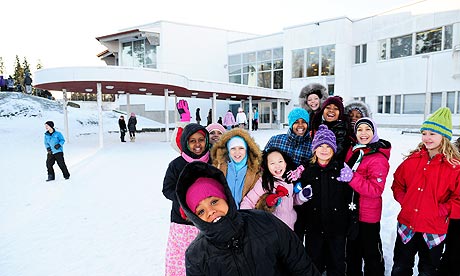

Also, it has often been said that providing a consistently high standard of education is easier in Finland, with its highly homogeneous society, than it is in a multicultural place like Britain. However, recent studies seem to contradict this analysis as Finnish schools with higher than average immigrant students are also producing superb results.


With this kind of education system, it's therefore unsurprising that the social and economic balance that Ms Toynbee is after is alive and well in up north in Finland. And, even if its still no Utopia, and not everybody manages to bag their dream career, it's still a pretty good state of affairs when one's postcode and family wealth are less important in determining later success in life than one's work ethic, initiative and individual choices.

6 February 2012

A new president at the top of the world

The winner, Sauli Niinistö
Finland has chosen it's 12th President, the Kokoomus (National Coalition Party - broadly conservative and pro-business) candidate Sauli Niinistö. He won the first round of the election, and went on to gather 62,9% of the votes in the second round. Congratulations are in order. Sauli will become President Niinistö at the beginning of March. A lawyer by training - an entrepeneur as well, having run his own law firm in his home town, Salo - Mr Niinistö has previously held the positions of Minister of Justice, Minister of Finance, Deputy Prime Minister of Finland, Speaker of Parliament and, least importantly, but quite interestingly, Mr Niinistö is also the President of the Football Association of Finland. He has on several occasions retired from politics and high office after having previously run for President, but all good things come to those who try, revise, and  try again, it would seem.

The runner up, Pekka Haaavisto
The contrast between the winner and the runner-up candidate, Pekka Haavisto (Green Ulkopolitiikka called him the 5th most influential Finn on the international scene, and he has been highly popular with urbanites, environmentalists, artists and intellectuals, among others.
League), could hardly have been starker - unless Sauli was called Timo Soini (of the lamentably close minded True Finns). Mr Haavisto received 37,4% of the votes, which, although dissappointing to his followers and activists, is a remarkable amount considering the following: he is a Green, he is openly gay, he chose the civilian service over the military (Finnish men must complete one of these or the third option, prison, for their national service), and although he studied Social Sciences in university, he did not complete the degree. His strenghts, however, lay in international affairs in particular: he has worked for the United Nations, UN Environment Program, and the European Union in various capacities, which resulted in spells in Afganistan, Bosnia & Herzegovina, Darfur, Iraq, Kosovo, Liberia, Palestine, Sudan, to name but a few not alltogether friendly places. Haavisto is also a Member of Parliament and he previously served as the Minister for the Environment between 1995-99. The foreign affairs magazine

The role of the President of Finland is mostly ceremonial, and they have little power over national or foreign policy. Their main function is to act as the premier representative for Finland on the world stage and in non-European matters in particular. The President is the figurehead of the country and a sort of brand ambassador for all things Pohjola.

Personally, I voted for the losing candidate. At first, I felt that it might not be in the country's interest to have a gay President with an Ecuadorian civil partner, not because I have anything against either - because I honestly do not - but because it might complicate matters and impinge on the national interest should the President need to, for example, drum up trade with less civilized and less modern countries, where the private life of the President might be given more weight than their skills and professionalism. This is only an indictment at certain parts of the world, where prejudices are still far more prevalent than in the West, but in the real world, this could result in less opportunities for Finland PLC. Sad but true - and, after all, we were not voting for equality or justice or morals, but for the person most suited to further the Finnish national interest.

However, although Niinistö ticked all the trade boxes, his downfall for me was having such views as libraries should begin charging for their services, and for being a tad out of touch with the fortunes of the less fortunate in society, along with the discernible arrogance which I felt he displayed in his television debate with Paavo Väyrynen. Still, I walked to the Embassy thinking Niinistö would get my vote, for the abovementioned realpolitik reason,  but when I was standing in the booth, looking at the two numbers, I couldn't help but feel: will I vote for the status quo where leaders must conform to the norm, or should I give my vote to the person who to me seems superior and thereby try to push the envelope of meritocracy, whatever consequences that may have for Finland's economy? I chose the latter - although I must confess that I thought Niinistö would nonetheless win.

In any case, the turnout was depressingly low, 68,9% - makes one think, why should people be allowed to avail of the benefits of a welfare state but not have to take part in its maintenance? - but the demos hath spoken. Congratulations to Niinistö - now just do the right thing and keep the libraries open because there is little more important for the health of a nation than making sure that people can keep themselves well read and informed. And, Mr Haavisto, you did a great job and even though now was not your time, you certainly made Finland step up and show the world what a progressive, egalitarian and open minded country it can be. This election, the way it was managed, the innovative part played by the media, and the positive result for such an unlikely candidate, showed us leading the world by example in all things meritocracy and equality. As Haavisto tweeted after the result, "these elections might be a wave toward something better, which has begun now." If not today, you have brought tomorrow a lot closer, Pekka - for that we thank you, and we can all be proud.


9 January 2012

Election debates à la Finland's channel Nelonen

The Finnish presidential election takes place next week and, as an expat, I need to catch up on politics in dear old Pohjola. Luckily, though, I just got a bit of help from my good friend, Joe, who sent me this video of Timo Soini (True Finns) and Pekka Haavisto (Greens). It's from a series called "Alone at last!", and each episode shows two presidential candidates going head to head in a debate on defence, employment, the Euro, foreign policy, etc. The format is simple yet ingenious: a 35 minute informal discussion without a moderator, with no breaks or any other outside interference.

I'd never seen an "election debate" like this before
  and it sure was refreshing. It could hardly be more different from the extravagant set pieces seen in American presidential races, where such is the intensity of the limelight that candidates resort to making $10,000 bets on policy issues. There was no spectacle in Nelonen's debate, no lights, fireworks nor music. Just two candidates talking like normal people, albeit ones with highly formed opinions on current affairs.

This novel format was also a lot more interesting than the largely artificial debates that took place for the UK's general election, where none of the candidates really said much of substance for fear of upsetting some portion of the electorate. Britons were simply offered platitudes and play-doh politics with the same things being said, regurgitated, refashioned and repeated with a slightly different twist, over and over again, ad nauseaum.

Perhaps the best thing about Nelonen's "face-off" format is the way it takes away from the politicians the comfort of 
breaks, when the cameras are on their adversary, for example, during which to regroup their thoughts. A constant conversation with a single interlocutor also forces them to keep up with the game without recourse to notesWhile they've no doubt prepared and been given some kind of framework for discussion and topics they are expected to cover, a lesser politician could easily find themselves in trouble having to perform, discuss, debate, argue, retort, provide evidence and, simply, be cool, natural and approachable for over 30 minutes without any respite.

It's a bit like the difference between rugby and the NFL. The former is a drawn out affair that flows on its own momentum, providing few chances for the team to revise battle lines or change tactics once play has begun. The latter, by contrast, requires action in bursts, with the game stopping every few seconds, giving both sides the opportunity to redraw formations and revise strategies at every possible turn.

Now, which would you say provides a better approximation of real life and the real world: a constant flux, like rugby, or dispersed events with precise intervals, like American football? Well, I would argue that both life and politics are in a constant state of movement and change. Anyone wanting to succeed in either best keep up with the blooming buzzing confusion or be prepared to suffer the consequences.

Anyway, watching this debate, I soon realised that I'd never before seen politicians behaving in this way: like normal people discussing stuff mano a mano and debating policies over a cup of java. It was in stark contrast to how we are used to seeing our elected leaders: in the spotlight at press conferences, being interviewed, giving speeches, or electioneering on the campaign trail  all of which are situations that we the public don't have much experience of.

Indeed, as a result of its familiarity, the mundane set up made it far easier to gauge these two candidates, and not just their politics but also their personality and character: are they easily flustered or do they come across as arrogant? Are they able to provide facts and figures to support their arguments? Do they stay on topic or do they try to weasel their way out of questions? Do they resort to ad hominem attacks? In short, do they stay cool under sustained fire from their opponent and do they know their stuff?

As long as the participants don't conspire to agree their conversation in advance  but as they represent different parties and are all after the same position, it wouldn't make much sense for them to do so  dare I say this new format might even be better for democracy. 

Firstly, it forces our decision makers to actually engage their competitors one-on-one and, as we see in this video, to their surprise, the pair find themselves agreeing on more than they previously thought. Second, as it's an organic discussion, there is less chance of others influencing the proceedings, whether it were the Party, the network airing the debate, or lobbyist who may be able to sway the process of picking questions and/or the audience. Finally, and perhaps most importantly, it sheds our elite of at least some of their trappings of power (stage, lectern, spotlights, audience, prewritten speeches, etc.), and shows them for what they  and we all  are, just normal blokes and lasses.

So, good on you Nelonen  and other channels take note.

***

I certainly won't be voting for Timo Soini, so repulsive are many of his views and so short-sighted are the majority of his policies. That said, one has to give the man credit for his uncanny ability to create easily digestible nuggets of political propaganda that will surely appeal to a whole lot of Finns. Mr Soini is remarkable in his ability to encapsulate complex issues into commonsensical soundbytes, but they are, however, nearly always factually incorrect or incomplete, and often morally reprehensible. As a result, watching this video makes me even more nervous that he might win, but I trust the majority of us will see through him and the shallow worldview that he and his close minded ilk represent.

Pekka Haavisto comes off well in the video. His grasp and experience of foreign policy shines through strongly. He may yet become a surprisingly strong contender. 

... but needs must I continue catching up on the other candidates, starting with the conversation between Sari Essaya v Eva Biaudet from the same series. And here's Sauli Niinistö v Paavo Väyrynen. And here's Arhinmäki v Lipponen.